
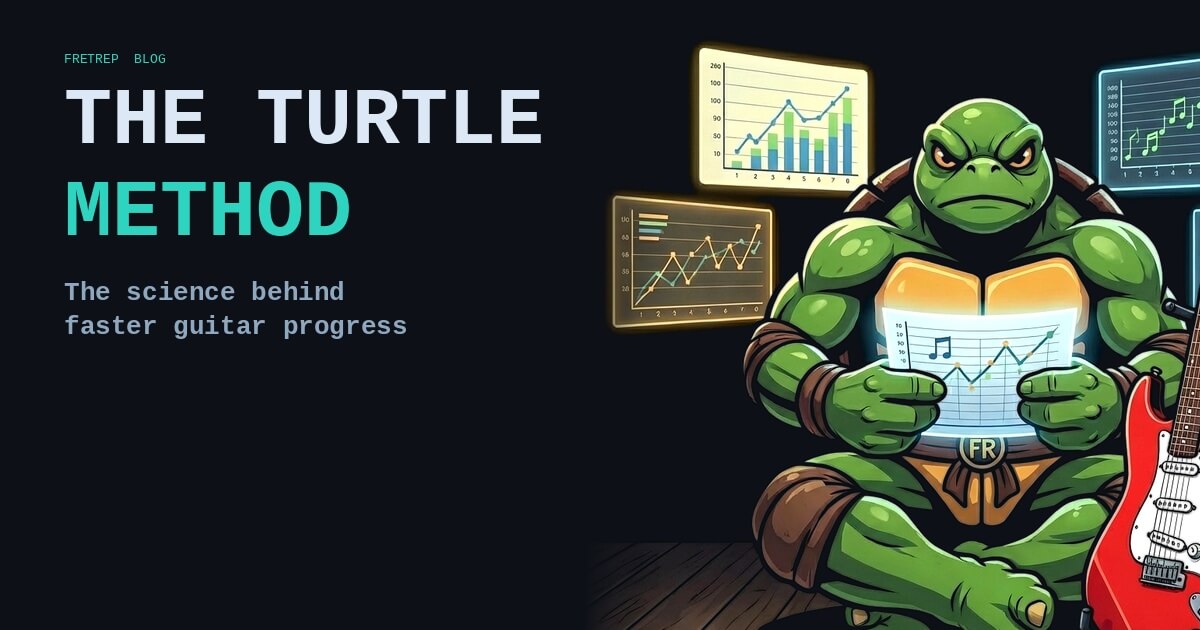
The Turtle Method: The Science Behind Why Slow Practice Makes You a Faster Guitarist
I read the story of the hare and the tortoise when I was a child.
I'll be honest with you — I thought it was rubbish.
Why Most Guitarists Who Want to Learn Guitar Faster Are Doing It Backwards
I was not a child who read that story and felt inspired. I was a child who felt suspicious. Slow and steady wins the race. Sure. That is what you tell someone who cannot run fast. That is what adults say to keep children quietly at their desks, not asking inconvenient questions about why any of it matters.
I filed it away with the other things I was told and did not believe — be patient, good things take time, trust the process. The vocabulary of people who had already given up on speed and were making peace with it.
After a lot of life happened, I picked up a guitar. And life, as it has a habit of doing, began to teach me a lesson. And I smelled the same story crouching its way back into my conscious.
What the Frustration Actually Felt Like
There was a period where I practised with everything I had and moved with nothing to show for it. Where I watched other guitarists — some who had started after me — play things I could not. Where I pushed harder and the pushing made it worse, not better. Where I genuinely considered whether I had a ceiling, and whether I had already hit it.
The frustration was not about the guitar. It was about the gap between who I believed I was and what my hands could prove. That gap, for a while, felt permanent. I am sure you have felt it too sometimes.
What I did not know — what nobody had told me, and what I had to find in pieces from books and scientists and the slow accumulation of honest observation — was that the mechanism of improvement is not what most people think it is. It is not willpower. It is not hours. It is not talent, though talent is real and willpower matters at times. It is something biological, quiet, and absolutely indifferent to your frustration. It is myelin.
The Neuroscience of How to Practice Guitar Effectively — and Why Slow Works
Here is the thing about your brain that changes everything once you understand it.
Every movement you make — every chord shape, every picking pattern, every shift up the neck — is a signal. An electrical impulse that travels along a neural pathway, from the brain to the fingers. The first time you attempt a movement, that pathway is thin, slow, unreliable. The signal stutters. The fingers hesitate. The chord buzzes. You know this feeling intimately.
But here is what happens when you repeat that movement correctly: a substance called myelin — a fatty sheath — wraps itself around that neural pathway. Layer by layer, repetition by repetition. And with each layer, the signal travels faster. Cleaner. More automatically. What required conscious effort begins to require less. What felt impossible begins to feel possible. What felt difficult begins to feel natural.
This is not metaphor. This is neuroscience. Myelin and learning are directly connected — measurably, documentably, in ways that have profound implications for anyone developing a physical skill. A musician. An athlete. A surgeon.
Daniel Coyle spent years investigating this. He travelled to talent hotbeds around the world and found the same thing everywhere. Not better genes. Not more hours. A specific quality of practice that triggered deep, rapid myelination. He called it deep practice. The bad news: myelin only grows on circuits that fire correctly. Sloppy repetition at high speed does not build myelin efficiently. It builds the wrong thing efficiently — reinforcing the mistake, wrapping the error in insulation, making the bad habit faster and more automatic. Speed practised before correctness is not practice. It is the industrious construction of a problem you will spend years trying to undo.
The good news: slow, precise repetition — where the movement is correct, where the signal fires cleanly — builds myelin faster and stronger than any other method. The tortoise was not losing. The tortoise was myelinating.

The Turtle Curve — How to Learn Guitar Faster by Going Slower
Which brings me to the thing I eventually built my entire practice around. The thing that is now the backbone of how FretRep tracks progress. I call it the Turtle Curve.
It works like this. You start at your comfort level — the BPM where you can play the passage cleanly, without tension, without mistakes. Not fast. Not impressive. Just correct. This is your baseline.
From there, you push. Slowly, incrementally, you raise the tempo until you reach your difficult level — the point where the movement starts to break down. You hold there briefly. You feel the edge of your current capability. Then you come back down to a session target level that sits above your original baseline. A tempo that felt like effort an hour ago and now feels, surprisingly, manageable.
This is not coincidence. This is myelin doing its work. The ceiling you were pressing against has risen slightly. The floor has risen with it. You do this enough times and the goal you set at the beginning arrives. Not because you forced it. Because you earned it, layer by layer, in the only way the brain actually knows how to receive it. And the skill is clean. The myelin wrapped the right circuits. The tortoise wins — and this time you understand exactly why.
Flow — The Address You Arrive at When Everything Is Working
Mihaly Csikszentmihalyi spent his career studying the state that musicians, athletes, surgeons, and artists describe as being in the zone. Fully absorbed. Time disappearing. The self dissolving into the activity. He called it Flow.
Flow occurs at a specific intersection: when the challenge of what you are doing is perfectly matched to the skill you currently possess. Too easy and the mind wanders. Too hard and anxiety replaces absorption. But at that precise balance point — the edge of your current capability, which is exactly where the Turtle Curve places you — Flow becomes available.
The tortoise was not just winning the race. The tortoise was, without knowing the vocabulary for it, living in Flow. Steady. Present. Exactly at the edge of capability. Not bored. Not panicked. Moving.
Back to the Root Note
I read the story of the hare and the tortoise when I was a child. I thought it was rubbish.
It took years of frustration, failure, and the slow accumulation of evidence — from neuroscientists, from musicians, from my own hands on my own guitar — to understand what that story is actually saying. It is not telling you to be slow. It is telling you to be deliberate. The signal matters more than the speed. Correctness, repeated, compounds.
And one day, without quite knowing when it happened, your hands play what your mind imagined. That is the method. It always has been.
Slow and steady. Always. — Rex 🐢