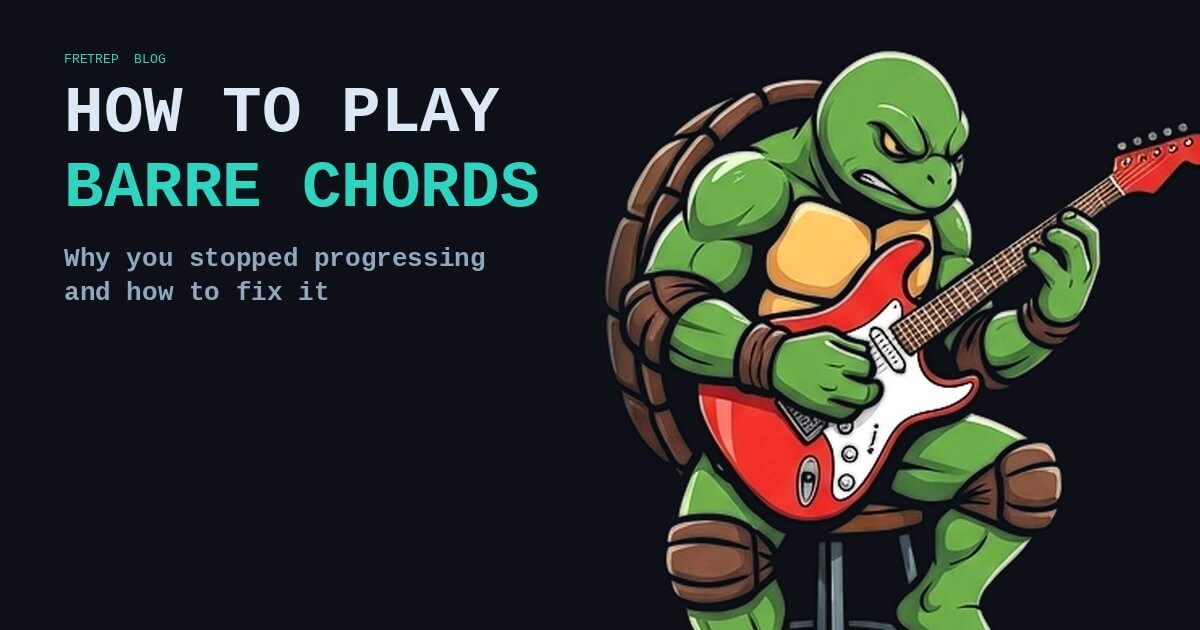
How to Play Barre Chords — Why You Stopped Progressing and How to Cross the Wall
My fingers hurt. Not the deep, satisfying hurt of something being built. The other kind.
It was telling me something. I just did not know how to listen yet.
How to Play Barre Chords — Starting With Why They Stop You Cold
When I first picked up the guitar, I thought I was signing up for music lessons. I was wrong. I was signing up for the gym.
Nobody tells you this at the beginning. Nobody sits you down and says — look, before you think about scales, before you think about songs, before you think about anything that sounds remotely like music, your fingers have to learn to walk on the fretboard. Just like you learned to walk when you were a child. One uncertain step at a time. Falling. Getting up. Trying again. And it is going to hurt. Just the feeling a new aspirant gets during his first few days at the gym.
The fretboard is the gym. The fingers are the new recruit. In the beginning — from my own experience, from watching others — it is eighty percent gym training and twenty percent music. Maybe ninety and ten. The ratio embarrasses people when they hear it. It should not. It is just the facts.
That is what C major is. That is what A minor is. E minor, D major, the open chords that every beginner plays and every advanced guitarist still uses. They are your squats. Your push-ups. Unglamorous. Foundational. The thing your fingers have to learn before they can learn anything else.
Why Are Barre Chords So Hard? The Wall Has a Name. It Is Called F Major.
So there I was. C major. A minor. E minor. D major. Even G — the intimidating one with the stretch. I had them all. My fingers knew where to go. My chord changes were getting cleaner. I was starting, for the first time, to sound like someone who played guitar.
And then I met F major.
The first full barre chord. The index finger pressed flat across all six strings, the other fingers forming the shape above it, the whole thing requiring a kind of grip and control that nothing before it had asked for. I put my finger down. I strummed. The guitar produced a sound that I can only describe as a polite disagreement.
I did not practise F major harder. I practised around it. I found songs that did not need it. I kept playing the things I could already play — getting better at never getting better — while F major sat on the fretboard like an unanswered question.
The barre chord is not just a chord. It is a wall. And everything magical is kept behind it. That is a chasm you have to cross to reach the magical land of opening the entire fretboard to yourself.
Guitar Calluses — What They Actually Mean
The pain in the fingertips at the beginning — the surface pain, the skin pain — is not a signal that something is wrong. It is a signal that something is changing. The skin is toughening. The guitar calluses are forming. And once those calluses are there — once the surface pain is gone — something shifts. Not just in the fingers. In the mind.
Because until the calluses arrive, every practice session has two battles in it. The battle with the chord, and the battle with the discomfort of playing at all. Once the calluses form, one of those battles disappears. And suddenly the full attention is available for the actual work.
The barre chord is the pull-up. F major is the pull-up. Not because it is the hardest thing on the guitar — it is not, not by a long distance. But because it is the first thing that asks your hands to do something genuinely new. Something that feels, at first, physically impossible.
Everything Is New Before It Is Easy
Every chord I can play cleanly today was, at some point, a chord I could not play at all. The difficulty was not a sign of inability. It was a sign of newness. And newness, given time and honest repetition, becomes familiarity. Familiarity becomes ease. Ease becomes second nature.
Once you cross F major — really cross it, not fake it with a shortcut voicing but actually play it clean and full — something happens to the fretboard. It opens. You understand, suddenly and with some force, that the same shape you just learned works anywhere on the neck. That B minor is F major moved up two frets. That every chord you will ever need lives in variations of shapes you already know, moveable, transposable, available everywhere. A luxury and a convenience that a pianist cannot have.
The wall was not keeping you out. The wall was keeping that world in — waiting, patient, for the guitarist willing to climb it.
Barre Chord Tips — A Word for the Ones Still at the Wall
Your hands are not wrong. Your fingers are not too short, too thick, too weak, or built incorrectly for this. The guitar is not broken. You are not the exception to a rule that works for everyone else.
You are at the gym. You are at the pull-up bar for the first time. And the only way to do a pull-up is to do a pull-up — badly, incompletely, with your feet still touching the floor if they need to — and then do it again tomorrow, and again the day after, until one day your feet leave the floor and stay there.
The dream that keeps you coming back does not need to be dramatic. It does not need to be a stage or a recording contract or an audience. It just needs to be real, and yours, and strong enough to bring you back to the instrument on the days when the instrument is not cooperating. That is enough. That has always been enough.
Back to the Root Note
My fingers hurt. Not the deep, satisfying hurt of something being built. The other kind — the surface kind.
That was then. The surface pain is long gone. What replaced it was not ease — it was a different kind of difficulty, the better kind, the kind that means you have crossed something and the territory on the other side is real.
F major did not get easier. I got bigger than it. And the fretboard — the whole beautiful, complicated, endlessly generous fretboard — opened up like a world I had not known was waiting.
Slow and steady. Always. — Rex 🐢